Why Movement and Sunlight Matter for Teens

Why Movement and Sunlight Matter for Teens

April is a great time to move more!

April is Move More Month, and it’s a good reminder that taking care of our mental health isn’t just about what’s happening in our heads, it’s also about how we use our bodies and where we spend our time.

When we work with teenagers in support groups, we often focus on conversations, relationships, and emotional support. Those things matter deeply, but something simple, like moving your body and getting outside can make a real difference in how teens feel day-to-day.

Movement Helps More Than We Sometimes Realize

Teenagers carry a lot. School pressure, friend drama, family stress, and social media can all
pile up.

One of the simplest ways to help manage that stress is movement.

When teens move, whether it’s sports, walking, shooting hoops, or just messing around outside, their bodies release chemicals that help boost mood and reduce stress. Movement can also improve sleep, which many teens struggle with.

Sometimes it does something even more important: it creates space to breathe and think.

We’ve seen it plenty of times in groups. A student might be quiet at first, but after a quick game or a walk outside, the conversation starts to flow a little easier.

kids playing soccer

Don’t Underestimate the Power of Sunlight

Another piece that often gets overlooked is sunlight.

Many teens spend most of their day indoors with classrooms, cars, bedrooms, and screens.

Getting outside, even briefly, helps reset the body’s natural rhythm. Sunlight supports the brain
chemicals connected to mood and helps regulate sleep cycles.

In simple terms, teens who spend a little time outside often sleep better, feel more alert, and
experience a boost in mood.

Even 15–30 minutes outside can make a difference.

Moving Together Matters

One thing we’ve learned over the years is that connection often happens more naturally when teens are doing something together.

Walking side by side, tossing a ball around, or playing a quick game lowers the pressure.

Sometimes the best conversations happen when teens aren’t staring directly at each other but moving alongside each other.
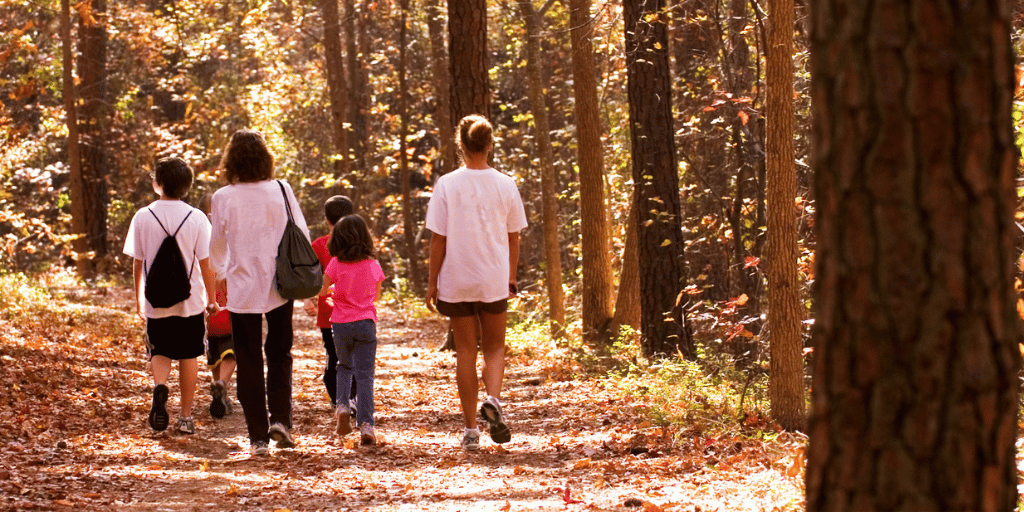
family walking on trail

A Simple Challenge

This month, encourage teens to try one small step:

Spend 20 minutes moving outside each day.

Walk, play, shoot basketball, or just sit in the sun with friends it all counts.

At Teen Life, we care about the whole student. Support groups create safe spaces for teens to talk about life and feel less alone. And sometimes supporting mental health starts with something simple:

  • Step outside.
  • Move a little.
  • Get some sunlight.

And do it with people who care about you.

Tobin Hodges
Tobin Hodges

Program Director

More Resources You Might Like
Title Image: Man hiking outdoors
how to stay mentally healthy while working with teens
how to help teens gain real-world coping skills

Getting Outside Ourselves

Getting Outside Ourselves

I’ve transitioned back to American life after being an expat for extended periods twice now from two different countries. Both times, the change that most impacted me on a daily basis was the difference in time spent outdoors. I found myself longing for the 15 minute walk to the grocery store or the classic Sunday stroll through town or the massive city parks where I had spent evenings and weekends walking and picnicking. In fact, I usually averaged 3-5 miles of walking in a day, without trying to work it in as exercise. Getting outside was easy. It was part of everyone’s daily life.

Most Europeans I know love being outdoors. They make it a priority in their free time. But life itself demands it, no matter what. You simply can’t drive everywhere, which forces you to walk. No matter the weather.

In Texas, we are often ready with an excuse for why it’s not ideal. It’s too hot or too cold or too rainy. There’s nothing forcing us outdoors, and it’s not socially acceptable to be hot and sweaty anywhere outside of a workout.

Let’s take the enormous amount of time we spend on our screens out of the equation. Unless you live in a place like New York City, a day running errands means that you are in the car most of the day. We drive to a place, go inside to complete our task, and return to the car.

But scientists and researchers have long been mounting evidence that being outside is not only good for us. It’s necessary.

It improves our mood and benefits our mental health.

There are 3 main theories why nature is so effective at improving our well-being. The International Journal of Wellbeing has a great article explaining why. But to summarize in layman’s terms, there are 3 main theories:

  • Until the last generation or 2 in the historical timeline, humans spent almost all of their time outdoors. Living the urban life is a pretty recent development. So it stands to reason, that we are biologically attuned to nature.
  • Natural environments capture our attention in a way that allows us to let go and live in the moment.
  • Nature calms us down and give our minds and bodies a chance to recover from stress.
Regardless of the reason, a myriad of studies have been done on various benefits from spending time in nature. They’ve concluded that even minutes of exposure to natural environments can:

One Danish study even found that children who lived in neighborhoods with more green space are 55% less likely to experience mental illness.

So it’s quite clear that spending time in nature is good for us, but how much and how?

In a study done in the UK of nearly 20,000 adults, they found that 2 hours per week gave participants significantly better health and well-being. It didn’t even have to be all at once.

But how?

That depends very much on your family and your lifestyle!

If you have tweens or younger kids in your house, I highly recommend looking into @1000hoursoutside and @wildandfree.co on Instagram or looking for the 1000 Hours Outside book by Ginny Yurich. You’ll be inspired with all the fun ideas and beautiful imagery.

Here are a few more ideas you might like, but I’m sure you’ll find more!
  • Pack a picnic lunch and head to your favorite green space. You can do this even during the week!
  • Visit the closest botanical gardens or arboretum. My family LOVES the Ft. Worth Botanical Gardens. It’s well worth buying the family pass and losing track of time there on the weekends (or some well-deserved PTO).
  • Google hiking trails near you and make it a family adventure or a staycation activity.
  • Go strawberry picking. Or any kind of fruit harvest is delightful! Tell me in the comments in you want local DFW options.
  • Take phone calls outside.
  • Instead of heading to the gym after work, head to the closest walking trail before or after work.
  • If you can, create an outdoor space at home where you can read, have dinner, invite guests. Even teenagers will get excited about this one once they try it!
  • This will sound crazy to Texans, but… even just opening the windows every once in a while can help!

Tell us in the comments what you like to do to get outdoors and where you like to go!


To read more

Ecotherapy: Theory, Research and Practice
Jordan, M., & Hinds, J. (Eds.), Red Globe Press, 2016

Environmental Neuroscience
Berman, M.G., et al., American Psychologist, 2019

Nature and Mental Health: An Ecosystem Service Perspective
Bratman, G.N., et al., Science Advances, 2019

Nurtured by Nature
Weir, K., American Psychological Association, 2020

Kelly Fann
Kelly Fann

Digital Media Manager